

Player Development
How to Help Your Child Tackle Safely and Confidently

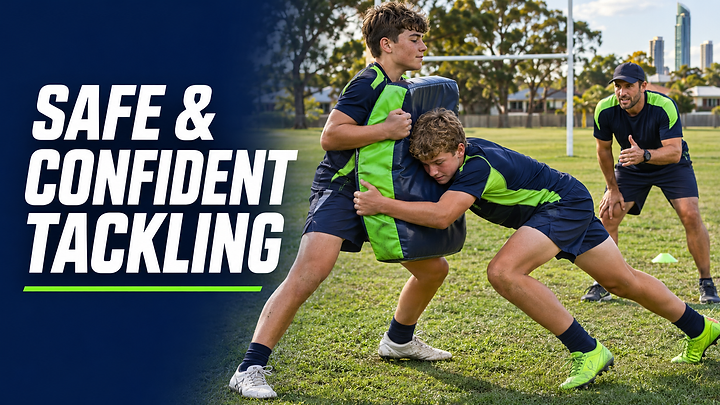
A practical parent guide to safe junior rugby league tackling, including progressive coaching, confidence, at-home boundaries, safety rules and useful questions to ask.
Safe tackling is not about teaching a junior player to hit harder. It is about helping them approach contact with control, use sound technique, protect themselves and their opponent, and build confidence through age-appropriate practice.
The short answer: junior players should learn tackling progressively with a suitably qualified coach. Start at low speed, practise both tackling and safe landing, and only add pace, space and decision-making when the player can stay controlled. Parents should not ask children to practise full-contact tackling unsupervised at home.
This guide is for parents of junior rugby league players aged approximately 9–17 on the Gold Coast. It explains what safe tackle development should look like, what parents can watch for and when a player needs to stop and seek help.
What does safe junior rugby league tackling involve?
A safe tackle is a whole sequence, not just the moment of contact. The player needs to track the ball-carrier, adjust their feet, choose an appropriate target, make controlled contact, wrap with the arms and finish the tackle without placing either player in a dangerous position.
The NRL’s TackleReady program uses a systematic introduction to tackling and being tackled. Its purpose is to build physical competence and confidence while accounting for differences in size, maturation and skill level.
For parents, the main point is simple: good tackle coaching should be progressive. Players should not be rushed from stationary technique straight into high-speed, unpredictable contact.
Five signs of a well-coached tackle session
1. The coach builds the skill in stages
Early activities may begin with body position, footwork, balance, controlled contact with a shield and safe landing. A coach can then add movement, an opponent and more realistic decisions as players show that they are ready.
The official TackleReady+ resources show this same principle by offering regressions such as walking or slow jogging before increasing pace or space.
2. Players practise both shoulders
A match does not always present the ball-carrier on a player’s preferred side. Practising both sides helps juniors move into a safer position rather than reaching, turning their head awkwardly or attempting a tackle from a poor angle.
This does not mean every repetition must be perfect. It means the coach should give the player enough time and feedback to become more comfortable on both sides.
3. The ball-carrier also learns how to be tackled
Tackle confidence is not only a defender’s skill. Juniors also need to learn how to carry the ball securely, stay balanced, respond to contact and land safely. The TackleReady framework specifically includes learning how to tackle and how to be tackled.
4. Technique matters more than winning the drill
If players are rewarded only for knocking someone backwards, they may chase force before control. A useful session rewards balanced footwork, appropriate contact, a secure wrap, safe finishing and a quick reset for the next play.
5. The activity matches the players
Age alone does not tell the full story. Confidence, experience, size, maturation and previous injuries can all affect how a player responds to contact. Coaches should adjust the drill, speed, space or pairing so that players can practise safely and successfully.
How can parents help a child who is nervous about tackling?
First, treat the concern as useful information rather than a weakness. A child may be worried about making contact, being tackled, getting their head position wrong or training against a much larger player.
Ask one specific question: “Which part of tackling feels hardest at the moment?” Their answer gives the coach something practical to address.
- Let the coach know what the player has said.
- Ask whether the skill can be slowed down or simplified.
- Focus praise on control, positioning and willingness to learn.
- Avoid telling the player to simply “run harder” or “smash them”.
- Give progress time; confidence usually grows through repeated successful experiences.
If confidence is affecting other parts of the game, read How to Help Your Child Build Confidence in Rugby League.
What should junior players practise at home?
At home, keep practice non-contact unless it is part of a properly supervised coaching activity. Useful foundations include balance, controlled footwork, changing direction, scanning, core strength and moving into a stable athletic position.
Ball skills and decision-making can also help a player arrive in better positions during a game. Try the non-contact ideas in 5 Rugby League Drills for Kids to Practise at Home.
Do not use siblings, friends or improvised objects for unsupervised full-contact tackling. A player needs suitable space, appropriate equipment, matched partners and coaching feedback.
What are the junior rugby league safety rules?
The National SafePlay Code applies to junior players through Under 15 and is designed to control dangerous actions. Current rules and competition conditions can vary by age, so families should follow the referee, club and governing body instructions.
For a plain-English overview of how the game changes across age groups, see Junior Rugby League Rules by Age: A Gold Coast Parent’s Guide. The official Play Rugby League policies and guidelines page provides access to the current SafePlay, concussion, return-to-play and other safety documents.
When should a player stop training?
A player should stop if they are hurt, feel dizzy or unwell, cannot maintain safe technique, or are too distressed or fatigued to continue controlled contact. Tell the coach or sports trainer immediately.
Any player with a suspected concussion should be removed from the activity and medically assessed. They must not return to contact simply because they say they feel better a few minutes later. The official NRL community concussion hub explains the current management and return-to-sport process.
Parents should also tell the coach about relevant injuries, medical advice or return-to-play restrictions before a session begins.
Questions parents can ask a coach
- What part of tackle technique is my child currently learning?
- How do you progress players from low-speed practice to game-like contact?
- How are players paired or grouped for contact activities?
- Does the session also teach safe landing and being tackled?
- What should my child practise between sessions?
- How will you adjust the activity if they lose confidence or technique?
Clear answers should describe a progression, not promise that one drill will remove every concern.
Build tackle confidence through better technique
Safe, confident tackling develops through patient coaching and well-designed repetition. The goal is not to make every junior player look identical. It is to help each player make better decisions, stay controlled and use a technique they can repeat when the game becomes faster.
If your child wants support with tackle technique, defensive movement or confidence in contact, contact 1Team Rugby League Coaching to discuss an appropriate development focus on the Gold Coast.
Sources and further reading
Official guidance checked on 3 November 2026. Always follow current club, competition, medical and governing-body requirements.