

Player Development
How to Improve Passing and Catching in Junior Rugby League
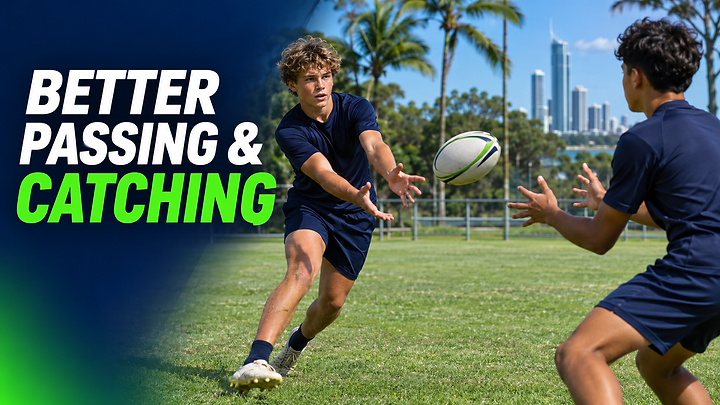
A practical guide for parents helping junior rugby league players improve catching, passing on both sides, support play and decisions under pressure.
To improve passing and catching in junior rugby league, players need three things: sound basic technique, lots of successful repetitions and practice that gradually adds movement, communication and defenders. Start slowly enough for the player to control the ball, then make the activity more game-like once the technique is reliable.
For Gold Coast parents, this does not require expensive equipment or a full field. A rugby league ball, a partner and a small safe space can be enough. The goal is not to throw the hardest or longest pass possible—it is to help the player deliver a catchable ball at the right time.
Why passing and catching matter so much
Passing and catching connect almost every attacking action in rugby league. A player needs to receive the ball securely, scan what is happening, communicate and transfer the ball without losing control or disrupting the team’s shape.
The Australian Sports Commission classifies throwing and catching as object-manipulation skills. As players develop, they move from simply controlling an object to changing the angle, speed and power of a throw in response to the situation. In rugby league, that means the skill eventually needs to work while running, under pressure and against defenders—not only while standing still.
What does a good rugby league catch look like?
Official Play Rugby League coaching points encourage players to:
- show their hands around chest or chin height
- spread their fingers and thumbs to create a clear target
- watch the ball into their hands
- receive it away from the chest rather than trapping it against the body
- secure the ball before preparing the next action.
A player who presents a clear target makes the passer’s job easier. Receiving the ball in the hands also helps them move quickly into a pass, carry or decision.
Common catching problems
- Hands appear late: the passer has no clear target.
- The ball is trapped against the chest: this can slow the next action and produce rebounds.
- The player looks away early: they begin scanning before securing the catch.
- They wait flat-footed: receiving with balanced movement is more useful for the game.
Use one short cue at a time. “Show your hands” or “watch it in” is more useful than giving four corrections after every dropped ball.
What does a good rugby league pass look like?
For a basic two-handed pass, Play Rugby League’s coaching guidance highlights holding the ball in two hands, stepping and turning towards the target, swinging the ball across the body and releasing when the hands line up with the receiver. The pass must also travel backwards under rugby league laws.
Helpful parent-friendly cues include:
- Two hands on the ball.
- Turn towards the target.
- Point the hands to the receiver.
- Make it easy to catch.
A hard spiral is not automatically a better pass. The right pass has enough speed for the situation while arriving at a comfortable height and in front of the receiver’s movement.
Five simple passing and catching progressions
1. Stationary partner passing
Stand three to five metres apart. Complete a small number of accurate passes in both directions. The receiver shows their hands and gives the passer a clear target.
Focus on the ball arriving between the receiver’s waist and chest. If accuracy drops, shorten the distance before changing the technique.
2. Catch, scan, pass
Place two coloured markers behind the passer’s partner. As the ball travels, the partner calls a colour. The receiver catches, identifies the colour and then passes back.
This keeps the skill simple while introducing the habit of collecting information. Make sure the player still watches the ball into their hands before looking away.
3. Passing while moving
Walk side by side at first, staying three to four metres apart. Pass the ball backwards to the partner while both continue moving. Progress from walking to jogging only when the player can keep their line, control the ball and deliver a catchable pass.
Avoid racing. Speed should be added after rhythm and accuracy.
4. Pass and support
Use three players or two players and a parent acting as a receiver. After passing, the player moves into a new support position rather than watching the ball.
This teaches that the job does not finish with the pass. Communication, spacing and effort after releasing the ball are important parts of team attack.
5. Add a decision
Create a simple two-against-one activity in a safe area. The ball carrier runs at a passive defender and chooses whether to pass or keep running. Begin with the defender moving slowly and increase the challenge as the players improve.
The Australian Sports Commission’s Game Sense approach supports modified games that develop technique and tactical understanding together. A decision-based activity helps players learn when to pass, not just how to pass.
How often should a child practise?
Short, focused practice can be more useful than one long session that becomes sloppy or frustrating. Ten to fifteen minutes may be enough for a young player to complete quality repetitions without turning family time into another compulsory training session.
A simple weekly approach could be:
- one short technique session at low speed
- one moving or decision-based activity
- normal club training and games
- at least one clear break from structured rugby league practice.
Extra passing work still contributes to the total training week. If your child is tired, sore or losing enthusiasm, review the full schedule using our guide to junior rugby league training load.
Should players practise both sides?
Yes, but expect one side to feel less natural. Begin at a shorter distance and slower speed on the weaker side. Do not compare the two sides after every pass; look for gradual improvements in grip, body position and accuracy.
A useful structure is to complete a small set on the preferred side, repeat it on the developing side, then finish with an activity where the player has to select the appropriate direction.
What should parents say during practice?
Keep feedback specific, brief and connected to the player’s current goal. The Australian Sports Commission recommends small doses of feedback and explains that a specific cue is more helpful than a vague statement.
Try:
- “That pass was easy to catch because it stayed in front.”
- “Show your hands a little earlier.”
- “Secure the catch first, then scan.”
- “Good support after the pass.”
Avoid reacting strongly to every dropped ball. Mistakes provide information about distance, speed, timing or technique. If frustration rises, make the activity easier or finish while the experience is still positive.
When should passing practice become more game-like?
Move on when the player can control the basic skill consistently at the current level. Add one challenge at a time:
- increase the distance slightly
- add walking, then jogging
- change the receiving angle
- add a time or space constraint
- introduce a passive defender
- let the defender create a genuine decision.
This progression preserves success while preventing practice from becoming disconnected from the game. For more ideas on reading defenders and choosing between running and passing, see how to improve decision-making in junior rugby league.
Safety and space at home
- Use a clear area away from roads, windows, vehicles and other people.
- Check the surface for holes, loose objects and slippery patches.
- Use non-contact activities unless a qualified coach is supervising appropriate contact training.
- Match the ball size, distance and challenge to the player.
- Stop if pain, dizziness or unusual discomfort occurs.
Parents looking for broader non-contact ideas can also use these five rugby league drills for kids to practise at home.
Build a pass that works in the game
A reliable pass is not built by chasing distance or speed. It develops through control, movement, communication and repeated decisions. Keep the early practice simple, celebrate catchable passes and gradually add the pressure the player will experience in a match.
If your child would benefit from structured feedback on their passing, catching and game understanding, contact 1Team Rugby League Coaching to discuss junior rugby league coaching on the Gold Coast.
Sources and further reading
Guidance checked on 17 November 2026.